Education has evolved significantly over the years. While traditional classroom learning has long been the foundation of academic development, industry-focused learning models are becoming increasingly important in preparing students for real-world careers.
Today, employers look beyond theoretical knowledge and value practical skills, project experience, and problem-solving ability. This shift has created greater interest in approaches such as live industrial training that combine learning with industry exposure.
Through programs designed around structured learning, such as the Coincent 3-Year Program, learners gain opportunities to bridge the gap between academic understanding and professional expectations.
Understanding Traditional Classroom Learning
Traditional classroom learning provides a structured academic environment where students learn concepts through lectures, assignments, textbooks, and examinations.
This model offers several advantages:
- Strong theoretical foundations
- Organized curriculum progression
- Academic discipline and consistency
- Conceptual understanding of subjects
Classroom learning plays an important role in developing core knowledge and establishing educational fundamentals.
However, traditional learning environments may sometimes provide limited exposure to real-world applications and current industry practices.
As technology and workplace expectations continue to evolve, learners increasingly require opportunities to apply knowledge beyond textbooks.
What Makes Live Industrial Training Different?
Live industrial training focuses on practical exposure and industry-oriented learning.
Instead of learning concepts only in theory, students experience how technologies, workflows, and projects operate in professional environments.
Programs such as the Coincent 3-Year Program emphasize structured learning supported by live training experiences, project-based execution, and guided development.
This approach helps learners move from understanding concepts to applying them in practical situations.
Industrial learning environments encourage students to think critically, solve problems, and work on challenges similar to those faced in professional settings.
Key Advantages of Live Industrial Training
1. Practical Exposure
Live industrial training allows learners to experience how concepts are implemented in real scenarios.
This improves understanding and creates stronger technical confidence.
2. Industry-Relevant Skills
Technology changes rapidly, and industrial training helps learners gain exposure to tools, processes, and expectations commonly used in professional environments.
3. Project-Based Learning
Working on projects encourages active learning.
Instead of memorizing information, students learn through implementation and experimentation.
4. Better Career Readiness
Industrial learning strengthens communication, collaboration, and problem-solving abilities that support long-term career growth.
These experiences help learners become more confident while preparing for future opportunities.
Why Combining Both Approaches Works Best
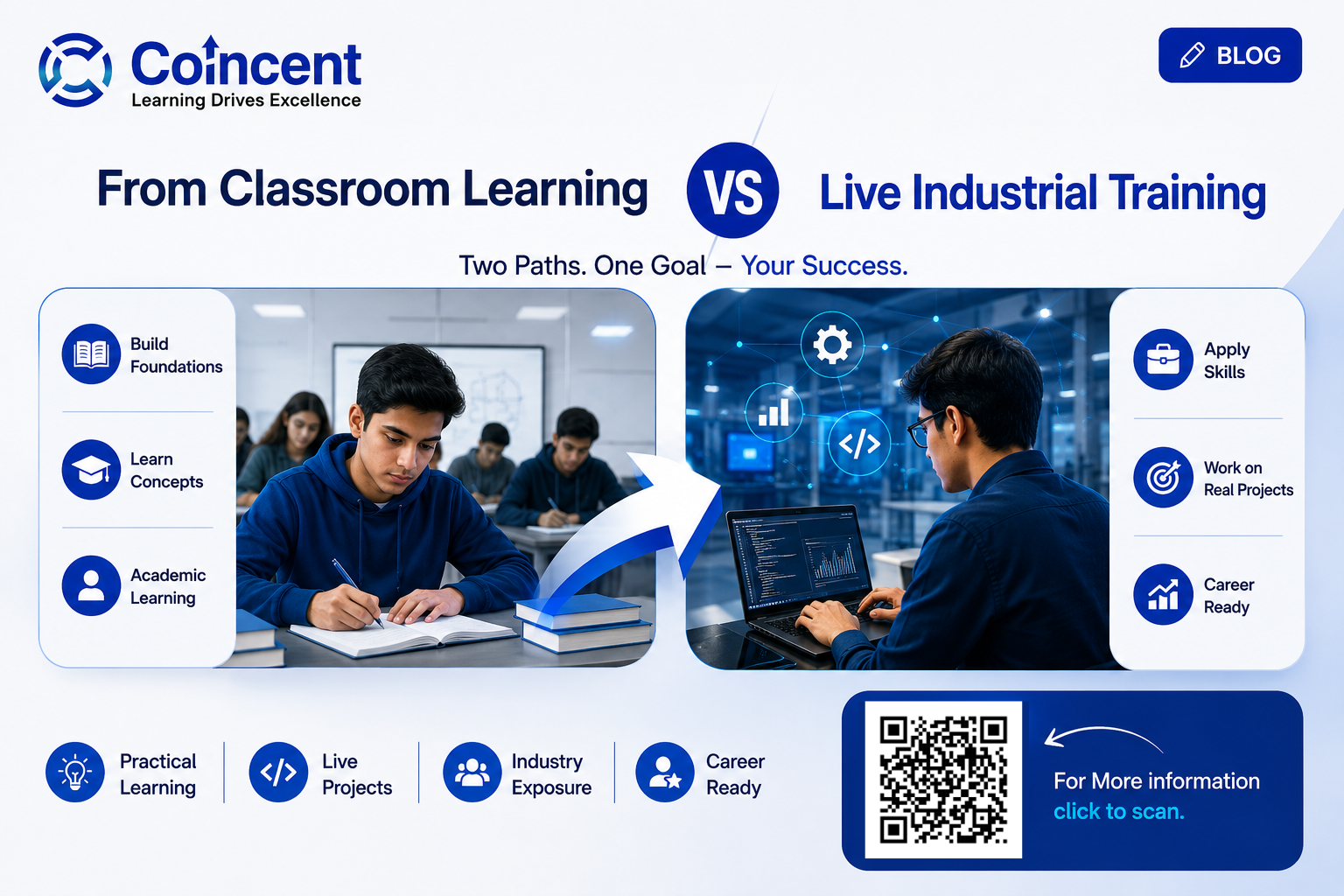
Live industrial training and traditional classroom learning should not be viewed as competing methods.
Both contribute important aspects of learning.
Traditional classrooms build strong academic foundations, while industrial training helps transform knowledge into practical capability.
The Coincent 3-Year Program follows this balanced philosophy by combining structured learning, practical projects, and industry-oriented experiences to support continuous development.
This combination allows learners to strengthen both technical understanding and real-world readiness.
Conclusion
Modern learning requires more than theoretical knowledge alone.
Traditional classroom education remains essential for building foundations, but live industrial training adds practical experience that prepares learners for industry expectations.
Programs that integrate structured learning with real-world exposure create stronger outcomes by helping learners apply knowledge confidently and develop skills that extend beyond the classroom.
Ultimately, the most effective learning journey is one that combines knowledge, practice, and continuous growth.