Certification exams have become an important part of professional growth and skill validation in today’s competitive environment. While preparing for certifications can initially feel overwhelming, having a structured learning approach makes the process more manageable and effective.
During my learning journey through the Coincent 3-Year Program, I realized that success in certification preparation is not only about studying more—it is about studying with direction, consistency, and practical understanding.
Here are some of the most valuable strategies that helped me prepare more effectively.
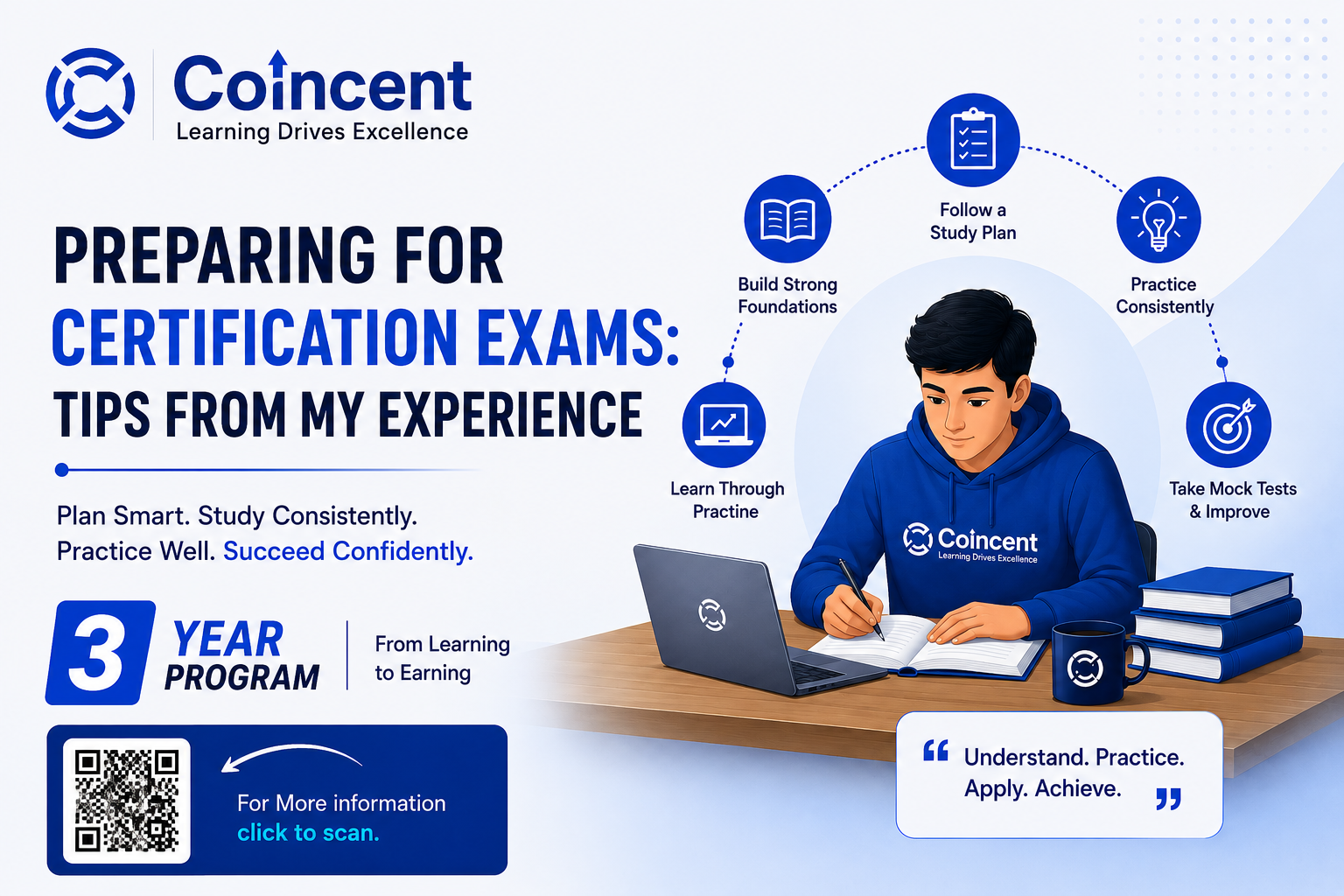
1. Start with Strong Fundamentals
One of the biggest mistakes learners make is jumping directly into advanced topics without understanding the basics.
My preparation improved significantly once I focused on strengthening foundational concepts first. The structured learning approach followed in the Coincent 3-Year Program emphasized building core understanding before progressing toward advanced applications.
Having a strong foundation made complex topics easier to understand and reduced last-minute stress.
2. Follow a Structured Study Plan
Certification preparation becomes difficult when learning happens randomly.
Instead of switching between multiple resources, I created a study schedule with clear goals and milestones. Dividing preparation into smaller sections helped maintain consistency and improved retention.
A structured roadmap made progress measurable and prevented information overload.
3. Learn Through Practical Application
Reading theory alone was not enough.
One of the most useful lessons I gained during the program was the importance of practical learning. Applying concepts through exercises, projects, and hands-on activities improved understanding and made technical topics easier to remember.
Practical implementation also increased confidence during exam preparation.
4. Practice Consistently Instead of Studying Intensively
Preparing for certification exams does not mean studying continuously for long hours.
I found that regular and focused study sessions produced better results than occasional intensive preparation.
Short daily learning sessions combined with revision helped reinforce concepts and reduced exam pressure.
Consistency became more valuable than speed.
5. Use Mock Tests and Self-Evaluation
Practice assessments played an important role in my preparation.
Mock tests helped identify strengths and areas that needed improvement. They also improved time management and increased familiarity with exam patterns.
Self-evaluation created clarity and helped prioritize topics more effectively.
6. Focus on Understanding, Not Memorization
One important realization during preparation was that certifications evaluate understanding more than memorization.
Instead of remembering answers, I concentrated on understanding concepts and their practical applications.
This approach improved confidence and made learning more meaningful.
Conclusion
Preparing for certification exams becomes more effective when supported by structured learning, practical exposure, and consistent effort.
My experience showed that success is not determined by the number of hours studied but by the quality of preparation and the ability to apply knowledge confidently.
The Coincent 3-Year Program reinforced the value of guided learning, practical implementation, and continuous improvement throughout the preparation journey.
Ultimately, certification success is not only about passing an exam—it is about building skills that create long-term professional growth.